
by Ross Bishop

There are two major issues that collide regarding gun violence and neither presents a good solution. Together they make for an intractable situation. The two parts are the guns themselves and secondly the people who commit violent acts with them.
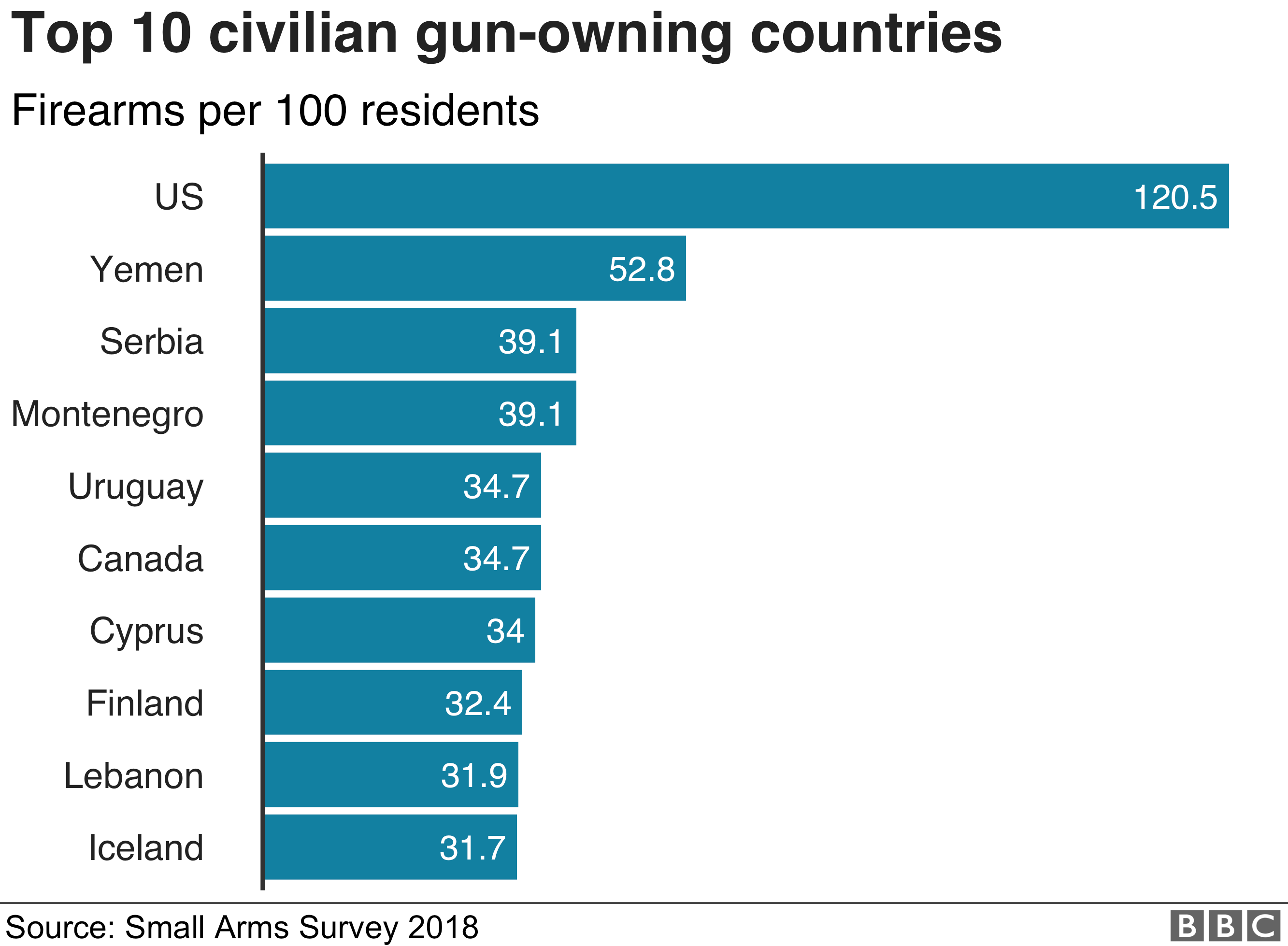
(Switzerland and Finland are two of the European countries with the most guns per person - they both have compulsory military service for all men over the age of 18. The Finnish interior ministry says about 60% of gun permits are granted for hunting - a popular pastime in Finland. Cyprus and Yemen also have military service.)
The people part breaks down into three distinct categories. The first, and least significant, are the mass shooters. Although they get all the publicity, there are about ten shootings year with a total of 150 - 200 victims. And as reprehensible as that is, and as much publicity as it generates, it is the blink of an eye when compared to the real problems of gun violence. Still, it is a situation that demands our attention. The terrorist impact of these events on the public’s consciousness cannot be ignored.

As regards to dealing with the problem, depending on whose estimates you accept, there are somewhere around a million young, angry, white men with the potential to shoot up a school, theater, nightclub or store. The problem is that it is impossible to pick out the 6 - 10 potential shooters from that group.
And even if we were able to undertake the Herculean task of whittling down the group to say, 10,000 men, you would still confront a considerable issue of civil rights and personal freedom issues that would make the task virtually impossible. In our legal framework a person is innocent until they commit some kind of violent act. There is no way to deal effectively with a “potential” threat. And attaching the stigma of “potentially violent” to a man would present a host of psychological, legal and civil rights issues.
Having said that, there are things we could do, that we are not doing, to identify and reduce the risk to society from this group of men. The legal and civil rights issues could be addressed. And dealing with the problem proactively would have considerable advantages to the society in other areas as well. By aggregating a host of resources such a teachers, school counselors, ministers, therapists, law enforcement and the courts, we could develop lists of potentially violent and dangerous men. Doing that would be beneficial for a host of reasons beyond just gun violence - from reducing domestic violence, addressing mental illness, breaking the cycle of violent father to son behavior, reducing drug abuse, unburdening the courts and jails and controlling white supremacy, all the way to conflicts with law enforcement.
The second group of gun traumas totaling about 115,000 injuries and 20,000 deaths each year, are a mixture of domestic violence and felony homicides. The majority of these are due to drug gangs, for whom guns are tools of the trade. These are almost never legally owned or acquired weapons, and somebody is making a great deal of money selling these guns on the black market.

I am going to leave criticism of the police for handling gang violence to the experts. Regarding domestic violence, there is a great deal we could do, but it is expensive, and rural politicians see this as a big city problem, so the political system has been reluctant to make the considerable investment such an effort would require. But again, that investment would spill over into beneficial results in a number of related social areas. Unfortunately people of color disproportionately bear the brunt of gun violence. Black boys and young men (ages 15 to 34) are 20 times more likely to die from gun violence than white boys.
The third group, the one rarely discussed, and the one with the most significant impact, are suicides. Suicide is among the leading causes of death to men in the United States, accounting for more than 40,000 deaths each year. The vast majority of suicides are committed by white men between the ages of 35 and 64. There is also a significant group of Native American men who commit suicide. And when you want to commit suicide, the easiest way to do that is to put a gun to your head.
Of course these men could be helped with psychological counseling, but the burden of shame we place upon them is horrific. When you consider that we rarely even discuss the issue of suicide, one of the major causes of death amongst men in the prime of life, speaks volumes to the social stigma of shame we place upon this unfortunate act. And no doubt that contributes significantly to its prevalence.
Regarding the other half of this equation - guns themselves - America is estimated to have 339 million guns, 46% of the world’s civilian guns. And we are in the unfortunate position, as a society, of having a recent rather violent past. Put simply, America has a legacy of civilian guns. Beginning with The American Revolution, the settlers of the West who had to kill game to survive and fight with Native Americans all the way to the cowboys who had to shoot wolves, mountain lions, rattlesnakes and cattle rustlers; civilian guns have played an essential part in the evolution of the country.
As recently as 150 years ago in the Southwest where I live, you had to carry a gun in order to survive. West of the Mississippi, guns are considered tools. They are generally not used for political statements or with body armor dress-ups like advertisements for “Soldier of Fortune" magazine. And in the East and West coast parts of America, the police have to deal with the Mafia and drug gangs. In addition, America’s decision to play the world’s policeman has also created a cultural acceptance of guns, violence and the military.

Most gun owners live under the fantasy that having a gun will protect them from a robbery. Research has shown us over and over that this is simply not the case. Having a gun at home only endangers other family members and provides burglars with a rich supply of cash when they sell stolen guns on the black market.
Then there is another misguided group of men who are convinced that their guns will somehow defeat a mythical government take over. As former Congressman Jay Dickey, Republican of Arkansas, said in January 2011, “We have a right to bear arms because of the threat of government taking over the freedoms we have.” The logic is that the more people there are with guns, the less able the government will be able to control them. This paranoid belief drives a deep seated psychological fear held by these men and when they get scared, they reach for their guns. But the premise is laughable. Jay Dickey has never seen the 82nd airborne in action.

The Second Amendment to the Constitution has given gun owners a tenuous right to their firearms. And they have ferociously defended that questionable right for years. In 1991, former Supreme Court chief justice Warren Burger, a conservative, referred to this charade as “one of the greatest pieces of fraud, I repeat the word ‘fraud,’ on the American public by special interest groups that I have ever seen in my lifetime.”
And in defense of gun owners, setting aside suicides, 99.9% of legitimate gun owners would never shoot up a school, a theater or a grocery store. So I think one can understand how unfairly treated they feel by the gun control movement. But the facts are that there is little else we can do to eliminate the problem but to ban or severely restrict gun ownership.
Some groups have proposed requiring gun owners to carry liability insurance. But amortized over millions and millions of gun owners, the comparatively few settlements would probably not present much of a deterrent. Besides, a check hardly takes the place of a murdered loved one or child.
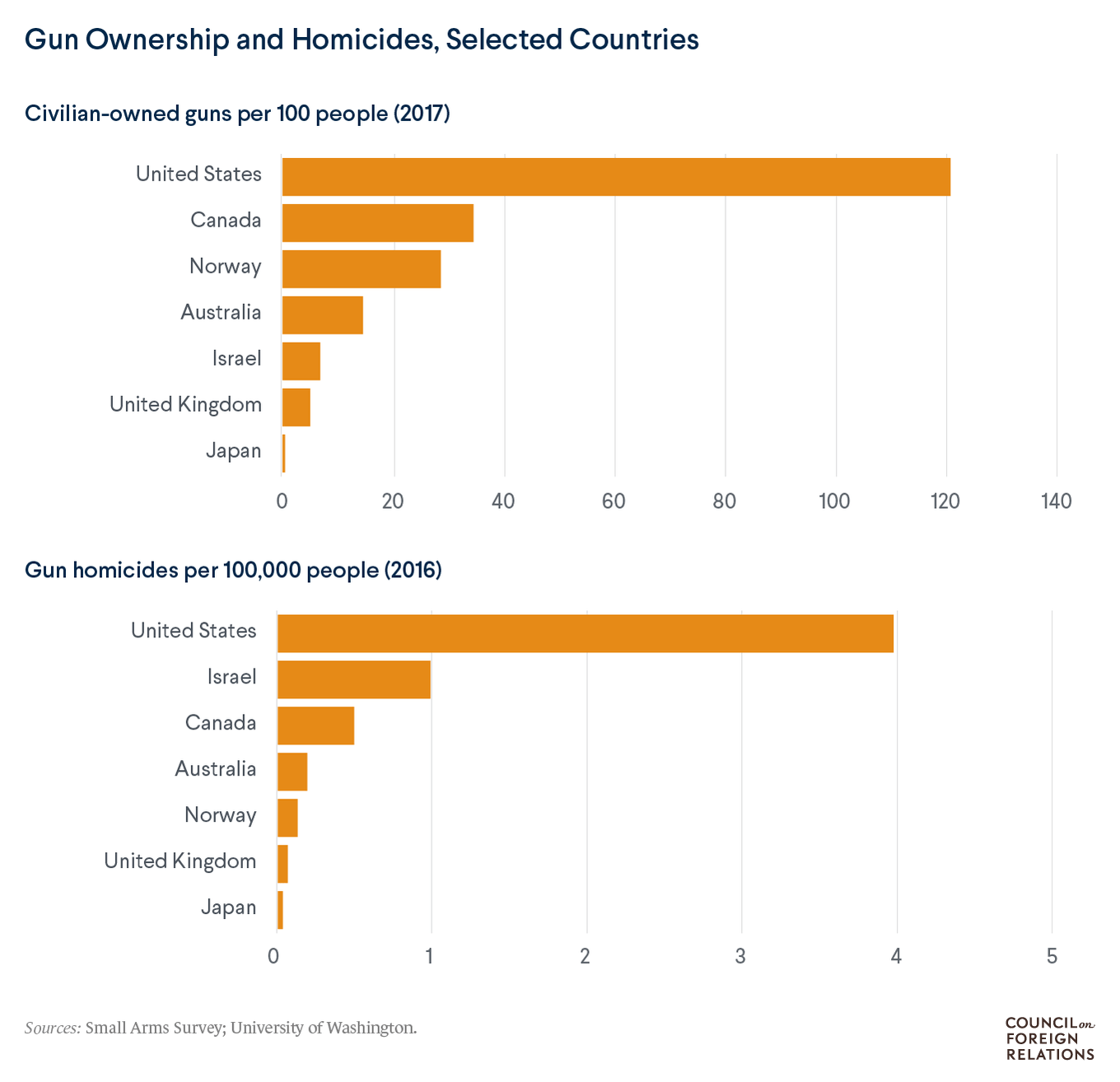
The simple fact is that no matter how unfair it will be to legitimate gun owners, other countries who have severely restricted gun ownership experience dramatically lower rates of violence. There is simply no refuting that fact. It is a draconian, but probably necessary solution, considering the circumstances.

Putting very stringent controls on guns as they do in Australia for example, has dramatically reduced their gun violence problem. And as Jeff McMahan, Professor of Philosophy at Rutgers writes,
Gun advocates must search their consciences to determine whether they really want to share responsibility for the perpetuation of policies that make our country the homicide capitol of the developed world.
South Africa passed its “Firearm Control Act in 2000” — banning automatic rifles, instituting background checks, permits and licenses. In the next five years, there was a 13.6% decline on average per year in gun-related firearm deaths. Austria passed a similar law and saw a similar result a few years before that. As Nicholas Kristof points out an an article entitled, How to Reduce Shootings,
For skeptics who think that gun laws don’t make a difference, consider what happened in two states, Missouri and Connecticut. In 1995, Connecticut tightened licensing laws, while in 2007 Missouri eased gun laws. The upshot? After tightening gun laws, firearm homicide rates dropped 40 percent in Connecticut. And after Missouri eased gun laws, gun homicide rates rose 25 percent.
There may be some political compromises we could make such as banning assault style rifles, semi-automatic handguns, “bump stocks” and large capacity magazines. Plugging the gaping loopholes in the gun registration and sales system could also help control abuse, but these are only partial steps to dealing with the larger problem.
Anything we can do to reduce gun violence would be helpful, especially if we could add a way to limit sales to troubled or potentially violent people. But asking gun store owners and private sellers, who want to make sales, to act as the social conscience of the nation, is just not realistic. But getting after the FBI and Treasury Department to take more aggressive measures to squelch the black market sale of weapons is an essential and necessary step.
Gun makers have thus far been unwilling to support efforts to help manage the problem. There have been many ideas for changes in technology over the years and the industry has steadfastly refused to implement any of them. After all, they don’t want to be in the awkward position of restricting sales to their customers.
My iPad won’t operate without my thumbprint, making it useless to anyone else. There is no reason that guns could not employ similar technology. And a long time ago guns were made to be child-proof, but the industry abandoned the concept. It is time to revisit that idea.
Combining smart guns with safe storage would reduce the number of firearms stolen each year, a significant source of supply for the black market. Changes, it seems will have come through new regulations, because the gun business in America is quite large - as America supplies the lion’s share of the world’s weapons, and the industry’s political influence is considerable.
copyright ©️ 2021 Blue Lotus Press
