
By Ross Bishop
The U.S. is at an important crossroads. For years conservatives have sucked the social system dry to support the wealthy and to drive an unholy anti communist, pro-military alliance. But with the infrastructure system in the U.S. screaming for attention and the world transitioning away from fossil fuels, the traditional way of doing things is going to have to change.
Socialist philosophy had guided the U.S. from before 1900 through the 1950’s. Labor unions prospered during the period, providing a decent wage, an 8 hour workday and safer working conditions for millions of workers. After the Wall Street meltdown of 1929, the government enacted Social Security, providing an economic floor to retirement and programs like banking reform, free state college tuition, and programs like the TVA that brought electricity for the first time to millions of rural families. Legislation like the Sherman and Clayton anti-trust acts limited the corporations’ insatiable appetite for power. The Socialist Party was a significant political influence in the country, posting Presidential candidates from before WWI through most of the 1930’s.
While many countries in Europe continued their progression of socialist policies after WWII, the U.S. turned abruptly to the right. The rise of Communism in Russia and China after the War with their (theoretically worker driven societies) was perceived as a threat to American corporations, which had gained considerable political influence during the War. Conservatism blossomed as a political force in America. The “Cold War” became an expression of the political and economic rivalry of these competing philosophies. Socialism and communism became anathema in America.
Socialists and Communists were “exposed” and purged - blacklisted - by McCarthyism of the 1950’s. The military-industrial complex continued to be a massive political force, as worker prosperity began its long decline into the present. Crowned by the Reagan years, the hallmark of American political philosophy became catering to the wealthy. The mistaken belief was that wealth would “trickle down” to the little people. It didn’t. it was stashed in yachts, the Bahamas and other tax shelters. Industries that had built America were piecemealed overseas for corporate profits. Poor people just needed to get jobs. The minimum wage has not changed in the U.S. for 12 years - since 2009.
The pendulum has begun to swing back in the other direction, but only time will tell how far it will go. In the meantime, we have some serious problems to fix.
INFRASTRUCTURE
The $20 trillion U.S. economy relies on a vast network of infrastructure from roads and bridges to freight rail and ports to electrical grids, clean water and internet availability. Many of the country's roads, bridges, airports, dams, levees and water systems are aging and in poor to mediocre condition and pose serious risks to public health. Civil engineers rank 11 of the 17 infrastructure categories in the "D" range. ASCE Executive Director Thomas Smith said, "We have not made significant enough investments to maintain infrastructure that in some cases was built more than 50 years ago.” Meanwhile, the industries of Americas’ international competitors (China) enjoy significantly more efficient and reliable services, while the U.S. lags seriously behind other developed nations in infrastructure spending.
Of particular concern is the condition of the nation's bridges. According to the Infrastructure Report Card, 42% of the 617,000 bridges in the U.S. are more than 50 years old, and 46,000 of them are rated as structurally deficient. An additional 14 percent are categorized as functionally obsolete.
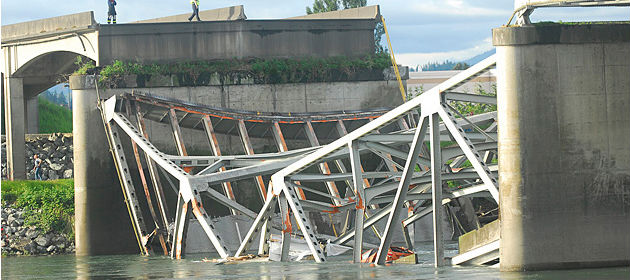
The $20 trillion U.S. economy relies on a vast network of infrastructure from roads and bridges to freight rail and ports to electrical grids, clean water and internet availability. Many of the country's roads, bridges, airports, dams, levees and water systems are aging and in poor to mediocre condition and pose serious risks to public health. Civil engineers rank 11 of the 17 infrastructure categories in the "D" range. ASCE Executive Director Thomas Smith said, "We have not made significant enough investments to maintain infrastructure that in some cases was built more than 50 years ago.” Meanwhile, the industries of Americas’ international competitors (China) enjoy significantly more efficient and reliable services, while the U.S. lags seriously behind other developed nations in infrastructure spending.
Transit systems in the U.S. get the lowest grade, a D-minus, as some 45% of Americans lack access to transit and the existing transit infrastructure, from subway tunnels to station facilities, is aging and in need of repair. While the rest of the world enjoys thousands of miles of high speed rail, the U.S. has effectively none.
Another concern is the state of dams, levees and stormwater systems. Dam and levee failures are happening more often as warming climate creates more severe thunderstorms with heavier rainfall amounts. Stormwater systems are also increasingly being overwhelmed, causing catastrophic flooding. Engineers say the U.S. is spending only half of what it needs to invest in improvements just to bring these systems up to par. They project a stormwater infrastructure funding shortfall of $2.59 trillion over the next 10 years.
The U.S. energy sector is in dire need of an overhaul. Most of the country’s electric transmission and distribution lines were constructed in the ‘50s and ‘60s and desperately need a 21st-century update. Current energy infrastructure is a combination of modern and practically ancient technology that can be very unreliable to storms and hackers while the rest of the world installs solar panels by the thousands and evolves to a green economy.
If the country doesn't pay its overdue infrastructure bill, ASCE estimated that the U.S. will lose $10 trillion in economic growth and will lose more than 3 million more jobs by 2039.
MILITARY SPENDING
Walter Cronkite said, “War itself is, of course, a form of madness. It is hardly a civilized pursuit. It’s amazing how we spend so much time inventing devices to kill each other and so little time working on how to achieve peace.”
President Biden recently asked Congress to appropriate $715 billion for this year’s military budget. That reflects about 2/3rds of the actual cost, and is somewhere between 50-55% of all Federal Government discretionary spending for the year. It is roughly equal to total of what the rest of the world spends on their militaries combined.
While the current U.S. military budget exceeds China’s military spending by 3-to-1 and Russia’s by more than 10-to-1, those nations, particularly China, are pouring out foreign aid to build roads, ports and bridges in third world countries. Choosing to be the world’s policeman and engaging in incessant war over the last 70 years is the major reason that the country’s infrastructure has been so neglected.
Let’s see if those dollars have been well spent: In just the last few years the U.S. wars in Afghanistan, Iraq, Syria and Pakistan have cost American taxpayers $5.9 trillion. And since 2011 more that 480,000 people have died - over 244,000 civilians have been killed and another 10 million have been displaced due to violence. But let’s take an even longer historical perspective:
1950 - 1953 The War in Korea - Outcome: we fought the Chinese army to a standstill.
Cost: $390 billion, 36,574 U.S. military deaths.
1965 -1975 Viet Nam War - Outcome: A complete American humiliation.
Cost $844 billion, 58,220 U.S. military deaths.
1990 - 2010 The Iraq wars. Outcome: A complete disaster.
Many, many civilians killed, the country’s infrastructure totally wrecked. Fought under the false premise that Saddam Hussein had weapons of mass destruction.
Cost $1.01 trillion 4,410 U.S. military deaths.
2011 - 2021 War in Afghanistan. Outcome: A humiliating defeat.
The Taliban will soon take over the country and use it as a terrorist base in the heroin producing capital of the world.
Cost $911 billion 2,282 U.S. military deaths.
By any reasonable assessment, the U.S. military, over the last 70 years, has been an enormous drain on the treasury and has produced basically nothing for the enormous expenditure of money and blood. However, the military industrial complex in America is vast, producing most of the world’s weapons of violence. At the same time, the army has parking lots full of tanks it will never use and we will have wasted $1.7 trillion on a jet fighter that is basically useless.

GLOBAL WARMING
What more can one say about this critical problem that hasn’t been said? There is a large disconnect between environmentalist warnings and the public (supported by a huge lobbying investment by the fossil fuel industry). The public is bombarded almost daily with warnings about some other possible environmental debacle, and yet the public remains largely unmoved.
If emissions continue, we could experience up to eight feet of sea level rise by the end of the century. The Gulf of Mexico and East Coast of the United States are experiencing some of the world's fastest rates of sea level rise. Miami is going to need an 8’ seawall! The East coast could someday be in Cleveland and the West coast in Tucson. Elsewhere, entire island nations face the possibility of going completely underwater.

Global warming impacts everyone's food and water security and it’s not just coastal areas: climate change is also linked with heavier and more frequent rainfall, leading to destructive inland flooding in regions like the Midwest. Climate change is a direct cause of soil degradation, which limits the amount of carbon the earth is able to contain. Some 500 million people today live in areas affected by erosion, while up to 30 per cent of food is lost or wasted as a result.
Conversely today, California reservoir water levels are so low that some hydroelectric power plants will be forced offline during the peak summer wildfire season. As I write this, the state’s water reservoirs are 50% lower than normal. And more water isn't coming: The mountain snowpack vanished two months ahead of schedule and California doesn't enjoy rainy summers. The Southwestern U.S. has been under severe drought conditions since 2000 . . . and so it goes.
And by the time the public wakes up, it will be way too late. And if you are concerned, but feel there is little you can do individually, why then are you not joining together to insist that your state and Congressional legislators act? They are afraid to do anything because of the considerable costs of remediation and political pressure from the right, so they need to know that you support them in these efforts.
This sounds incredibly far fetched, but sometime between the years 5,100 and 7,800, humanity has a 95% probability of becoming extinct.
GUN CONTROL
After every mass shooting calls go up for more gun control. The NRA maintains it is a mental illness problem. There is merit to both positions but each also has serious downsides. Fundamental to the argument is an understanding that a gun exists for only one purpose - to inflict violence. Most gun owners won’t admit this, but a gun makes them feel more powerful, a statement about what we do to men in this society.

We should have enacted stricter gun control regulations years ago. Ninety percent of Americans support comprehensive background checks for all gun sales, even including 70% of NRA members. And every day we do not enact those regulations, we pay a toll - 44,000 more gun deaths last year alone. And although it will help, there is also a large problem with this approach as regards school shooters
Until you abolish all guns, regulating the millions and millions of gun sales every year may help control a myriad of other social problems like drug gangs and domestic violence, but is unlikely to eliminate or control the 15 - 20 guys who will shoot up a school, a bar or their place of work. These shooters are a unique group, they do not stand out on any kind of profiling and they seem able to get guns, no matter what the restrictions are. There is little proof that gun control measures, by themselves, will have any real impact.
MENTAL HEALTH
Dealing with America’s mental health problem could also offer some help for dealing with school shooters, domestic violence and suicides, but it’s not likely to provide a total fix either. As I said, school shooters are indistinguishable from the millions of angry and frustrated men who are likely to commit such a heinous act. But taken together as a group, with with potential domestic violence abusers, gang bangers, potential sexual abusers, cases of serious depression and general social dysfunctionality, we could treat, and therefore prevent, a host of activities that cause great damage and disruption to society.
Have you ever noticed how rarely this subject is ever even brought up in patriarchal political culture? That is because no politician who wants to get reelected will 1. ever criticize male behavior on such a large scale and 2. shoulder the responsibility (and the costs) associated with resurrecting America’s god-awful mental health system.
In the 1970’s we determined that regional clinics were better at treating mental health problems than big centralized hospitals. So Reagan closed the big hospitals and never funded the regional clinics. The mentally ill were simply turned out into the street or put in prison, where they struggle to survive today. But not dealing with mental health is a lot like not dealing with global warming. Kicking the can down the road does not make the problem go away, it only makes it worse as the problem gets passed from fathers to sons.
And the mental health situation is getting worse (these are pre-COVID statistics). The prevalence of mental illness among adults is increasing. Before COVID, 19% of all adults faced some sort of mental illness, an increase of about 1.5 million people per year. The percentage of adults in the U.S. who are experiencing serious thoughts of suicide increases by about 1.5 million people every year. Youth mental health is also worsening to the point that 10% of American youth suffer severe major depression.
What is worse, 24% of adults with a mental illness report being unable to receive treatment. 60% of youth with major depression cannot receive needed help. Among youth with severe depression, only 27% receive consistent treatment.
And if we add in problems created by COVID, things get much worse. The number of people looking for help with anxiety and depression has skyrocketed by about 93%. More people are reporting frequent thoughts of suicide and self-harm than have ever been recorded. (Source of statistics: Mental Health America.)
If we had the resources (which we don’t at the moment) there are a great many things we could do to help these troubled men. But that is going to require a substantial commitment on the part of politicians. And angry men aren’t likely to lobby to change the situation. Perhaps someday women will be able to bring about a change.
But consider as just a blue sky idea, the creation of a public registry of troubled individuals. (Can you just hear the howls from the back benches already?) But in theory, we could call on ministers, teachers, therapists and even parents and bosses, etc. to recommend emotionally troubled people (men) to such a registry. We could then provide counseling and guidance to these troubled souls. That would help with gun violence, suicides, domestic violence, school shooters and a host of other problems, but it is an idea whose time has not come. Can you imagine the reaction of Americans to such a concept? You could hear the howling all the way from Oklahoma, Montana and Wyoming! In addition to legitimate concerns about violation of civil rights, the mere idea of such a registry would send today’s conservatives into the treetops!
copyright ©2021 Blue Lotus Press
