
by Ross Bishop
The subject of gun violence has been written about ad infinitum from almost every point of view. If you follow the hard liner’s logic, with more guns, we ought to be the safest society on the planet. Sadly, the opposite is true. Eliminating guns in this country, which is not likely to happen, would dramatically reduce the damage, but interestingly, would not solve the underlying problem of which guns are only a symptom. And resolving that malady is going to cost a great deal. But it is an act of incredible ethical irresponsibility to allow things to continue as they are today. Besides not making meaningful changes will cost us a good deal more in the long run.
Forty five thousand (45,000) people are killed in the U.S. by guns each year. In addition to that, 90,000 people are wounded. That is incredibly more than any other industrialized country. For example over the same period, France had 2,000 shooting deaths, Germany had 1,000, Italy had 800 and Canada, like the U.S. in so many other ways, had 875. The United States has far more lax firearm laws and policies than any other industrialized nation. Every one of those fatalities is regrettable, but America’s contribution is simply unconscionable, especially when you consider that others are managing the problem successfully.
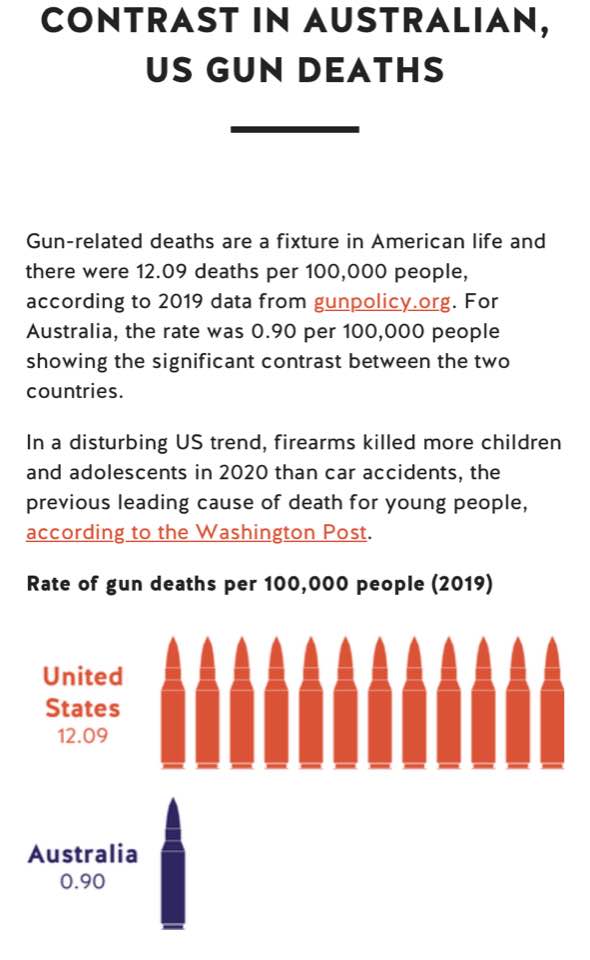
America’s gun violence epidemic is the result of a culture that has made guns available to nearly anyone with virtually no restrictions. Twenty five percent of gun sales today are for assault style weapons. Setting aside the ridiculous argument of deterrence, the only purpose a gun serves is to create mayhem. Considering the sizable effort the government puts forward for public safety and to prevent our food, water and drug supply from being contaminated, the refusal to regulate guns is an incredible contradiction. But prohibiting guns means putting an effective end to an $8.5 billion industry.
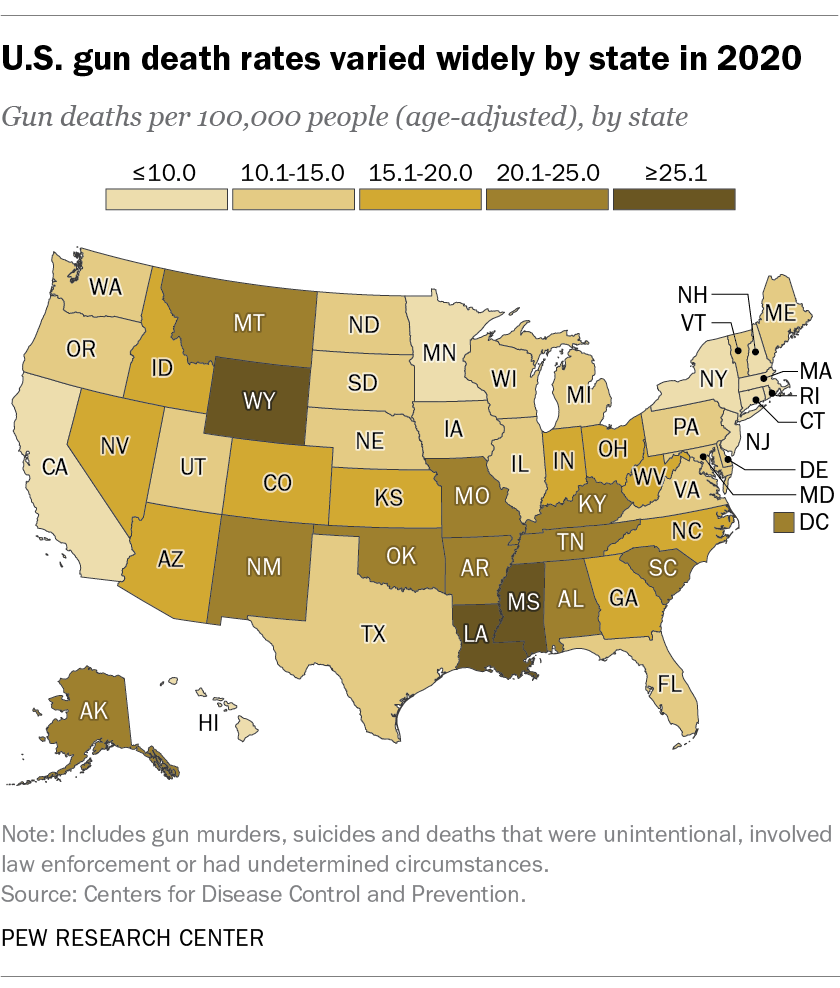
Gun violence is dominantly a male issue, and most prevalent in the American South. Nine out of 10 people killed by gun violence are men. The highest number of homicide deaths occur among young men aged 20-24, while gun-enabled suicides occur dominantly among elderly white males aged 55-59. Black Americans are 12 times more likely than white Americans to die by gun homicide.
Although almost daily mass shootings get most of the attention, thankfully the numbers of people harmed, are relatively small. But because they often involve the slaughter of innocent bystanders and children, they get the media’s attention. But suicides are the real profit center for the gun industry. Where mass shootings account for 600 - 700 deaths annually, suicides clock in at 25,000, as I said, mostly elderly white men. Homicides account for around 20,000 deaths each year, mostly amongst young black men. I intend to show that these three segments are linked.
But before I continue, I want to dispel one of the great Con Jobs, along with plastics recycling, that has been sold to the American people. And that is the great fraud of the Second Amendment that theoretically allows civilians to possess firearms. But don’t just take my word for it, consider the words of (conservative) former Supreme Court Chief Justice Warren Burger:
“(The Second Amendment) has been the subject of one of the greatest pieces of fraud, I repeat the word fraud, on the American public by special interest groups that I have ever seen in my lifetime.”
You cannot put it more forthrightly. If the U.S. Congress had any backbone, it would clarify this gross misinterpretation of the Constitution and fund the buyback of America’s guns - estimated to be over 390 million weapons. I will speak more about this later.
The most visible part of the gun problem are school shootings. These are horrid for any number of reasons. Shooting up a schoolroom of children is a heinous act. But, as I said, in comparison to the rest of the problem, the number of murders are thankfully, small. The 647 mass shootings last year, a significant increase over the last few years, garnered tons of publicity and killed about 650 people (2,500 were injured).
Republicans and the NRA like to dump the mass shooting problem off on the mentally ill. Mass shooters are severely psychologically troubled, to be sure, but only a few of them are actually mentally ill. The vast majority of the mentally ill, irrespective of Hollywood movies, are not violent. While other countries have similar levels of mental illness, none have the levels of mass shootings that the United States has. I raise this point because we can identify the mentally ill. But school shooters tend to come out of the woodwork.
Some guy with a twisted sense of hate or a warped desire for revenge on his parents or society, gets an AR-15 and heads out to take revenge on a target he knows will create a public uproar. And these men come almost, but not quite (and that’s important), out of the blue. Many, not all, of them could be identified if we really wanted to resolve the problem. (More about this later.) To repeat: we are talking about seriously troubled men.
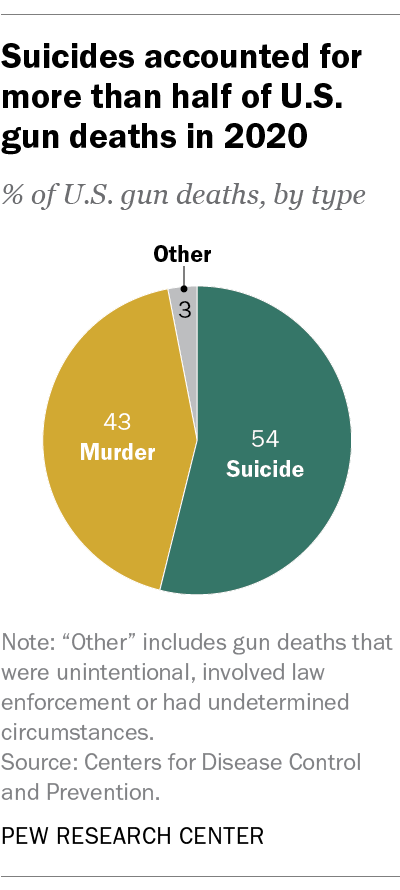
Though they get far less public attention than school shootings, suicides account for two-thirds of the nation’s 45,000 gun deaths, about 25,000 a year. Elderly white men, while they make up less than 35 percent of the population, account for 85 percent of gun suicides. Over the past 20 years, gun suicide has increased by about 33 percent, and men living in homes with guns are the most likely victims, according to the National Center for Health Statistics.
Dr. Mark Kaplan, a professor of Social Welfare at UCLA who researches suicides, says that major life events often serve as a catalyst for a person to commit suicide. Generally suicides are not planned but are the culmination of stressful events paired with mental health issues, leading to a “death of despair.” The onset of old age, physical infirmity and disease contribute significantly to an already depressed individual. So serious depression, along with “stressful events,” and an elderly status, is at the root of our largest category of gun deaths.
We don’t talk much about suicides because, I think, it is an embarrassment to traditional white society and the image of the successful businessman. As a result of one disturbing suicide report in 1996, the NRA and gun manufacturers successfully pushed Congress to ban government funding of gun violence research. It is my belief that if we were to apply sufficient resources, and identify potential suicide victims in a timely manner, many of these suicides could be prevented.
The third segment, homicides, come in at about 20,00 each year, and can be closely linked to America’s ghettoes. The ghettoes in America are virtual shooting galleries where everyone, if they want to survive, is armed. Jonathan Jay, an assistant professor at Boston University School of Public Health, maintains that, “There are two key factors driving community gun violence: disadvantage at the neighborhood level and exposure to gun violence at the individual level.”
Black Americans are twice as likely as white Americans to die from gun violence and 14 times more likely than white Americans to be wounded. The rate of firearm deaths for African American men aged 15 to 19 years is approximately four times the national average for all non-Black males the same age. It is the largest cause of death from any cause for this group. A large body of social research suggests that young people unfortunately learn they’re on their own in terms of keeping themselves safe. As one young Chicago ghetto resident put it, to not fight back would “open the flood gates to victimization.”
As researchers Sendhil Mullainathan and Eldar Shafir note in their book, Scarcity: Why Having Too Little Means So Much point out, “ . . . stress depletes mental bandwidth and leads us to default more to our automatic responses. In the most disadvantaged neighborhoods that are most challenging to navigate, stress makes that navigation even more difficult.”
Contrary to White Supremacists and political conservatives, this is not primarily a racial issue. Cram a bunch of white people together under those economic and social conditions, and you’d still end up with trouble. Jens Ludwig in a CNN opinion piece writes, “I saw this in one of the first research studies I was involved in, the federal government’s Moving to Opportunity (MTO) initiative. Starting in 1994, MTO helped families from economically distressed neighborhoods move to less distressed areas. Moving a few miles presumably didn’t alter a participant’s character, and the income of MTO families also didn’t change when they moved. Yet, violent crime arrests of MTO teens plummeted by almost 40%. What changed? The difficulty of the situations they faced.
Some of these homicides are about wars between gangs over drug-selling turf, but a lot of these conflicts actually start from something entirely unrelated. Arguments created under incredibly poor social conditions are most often the primary reason for these homicides. A neighbor won’t turn down their music. A landlord and tenant argue over unpaid rent. A group of teens think some other teens stole a bike. Someone gets cut off in traffic. All arguments that could have been de-escalated but weren’t – often end in tragedy simply because someone has a gun.
The key lesson we can take from research is that this type of criminal behavior is not fundamentally different from normal human behavior. Teens in affluent neighborhoods with lower instances of street violence are no more moral or thoughtful than teens anywhere else; it’s that affluent settings demand less deliberate thinking to navigate because their situations are more forgiving.
Ludwig continues. “A few years ago, I was visiting the Juvenile Temporary Detention Center in Chicago, which is where the teenagers deemed “highest risk” are held while their cases go through court. A staff supervisor told me he always tells the kids they’re not bad people, they’re just people who made bad decisions during enormously difficult situations. Or, as he puts it to them: ‘If I could give you back just 10 minutes of your lives, none of you would be in here.”
SOLUTIONS
What ties these three situations together - suicides, homicides and mass shootings - is the mindset of the individual in each situation. The common thread is that each individual feels alone and isolated by circumstance. What we have learned is that compassionate intervention, applied in a timely manner has a dramatic influence on the outcome.
Research tells us that the way to defuse these situations is to focus our efforts on changing the situations these people face and the tools they have for navigating those situations. We need to identify these people and give them a connection to the community through the efforts of another individual or group, to act as a deterrent to their impulse to act. The approach that has worked is a two step process: IDENTIFICATION and INTERVENTION. The approach varies somewhat in each situation, but the secret lies in finding ways to keep each individual from reaching for a gun to solve his problems. But first, we need to do three things:
1. Ban assault style automatic weapons and large capacity magazines and buy back these weapons.
2. Require that all firearms be kept at home under lock and key with ammunition stored similarly, but separately. (As Australia has done successfully.)
3. Create centers dedicated to the gun problem. Train cadres of intervenors: psychologists, social workers, religious leaders, former teachers and perhaps most importantly street people, and give them the skills and support to deal effectively with these situations.
SUICIDES
Create suicide help lines that will refer callers to caring individuals in a timely fashion. Create relationships between staff and at risk people - give potential suicide victims a caring lifeline connection, someone to turn to. Give family members, the police, ministers, teachers, guidance counsellors, etc. a place to refer potential suicides. Encourage the medical profession to refer elderly depressed male patients who are experiencing significant debilitating medical conditions to their local suicide center.
Follow up with each contact to determine the risk potential and introduce people to the program. Encourage at risk men (and their families) to participate in groups of other potential suicide victims. Then draw on these groups to provide additional staff to visit with other potential victims. Encourage at risk men to temporarily surrender their guns to the authorities. Enlist the support of organizations who work with the elderly like AARP, nursing homes, etc. in this effort.
HOMICIDES
Regarding homicides, we have learned that progress on the gun violence crisis is much more possible than we had thought in the past. Recent insights from behavioral science suggest that preventing gun violence isn’t about dealing with bad people, it’s about creating the situations that give young people those key 10 minutes back. Community-based violence intervention (CVI) programs are proving to be an effective solution to combat gun violence and curb firearm-related deaths in urban centers.
Violence interruption models have tremendous potential to save lives and address the contributing factors to gun violence in communities. Using the models of successful violence intervention, organizations like Chicago’s Cure Violence and Becoming a Man (BAM) programs, ROCA in Baltimore, or South Bronx’s Save Our Streets (SOS), or Advance Peace in Richmond, CA and Fort Worth, Texas, employ a violence interruption model that seeks to reduce gun violence by meaningfully engaging with the individuals at the center of the problem.
At the heart of violence interruption programs are neighborhood change agents who build trust and form the personal relationships needed to mediate conflict. The implementation of violence interruption programs has been responsible for a 63 percent decrease in gun shooting victimization in South Bronx and a 43 percent reduction in gun-related deaths and assaults in Richmond, CA. (source: Center for American Progress.)
Community-based violence intervention runs directly counter to the notion that incapacitating people is the only way to reduce gun violence. And in the context of America’s traditional approach to violent crime, that’s a radical idea. Conventional wisdom has been that crime is a product of bad people. That led us to focus on a narrow set of policy responses that created the world’s largest prison system. Our improved understanding of human behavior helps us see that you don’t throw someone in prison for life if you think they can change.
Strongly encourage the Congress to expand programs like the Moving to Opportunity (MTO) initiative to help families move from economically distressed neighborhoods to less distressed areas.
Bringing jobs into the hood has been talked a lot, but has never received the support to make it happen. On a somewhat related note, I spoke with a young man recently who clears two thousand dollars a week from his drug business. Opening a McDonald’s in his neighborhood isn’t going to attract his interest, but he might buy the franchise and with his management skills, make it a success!
MASS SHOOTERS
Identifying mass shooters will be difficult, but not impossible. Family members, neighbors, employers, teachers, school counsellors, ministers, psychologists, etc., could be a great source of information about troubled individuals. Sometimes, these individuals post manifestos or express their frustrations on social media, and so requiring social media to report questionable postings would also be a great help. They can be expected to resist, so establish an independent monitoring operation, with significant safeguards to protect freedom of speech.
From these various sources, lists could be developed of people in need of help. All of them could be offered individual or group help. Potential shooters could be identified from this group. These people would be red flagged regarding gun sales. If resources were sufficient, all of these people could receive the help and guidance that they need.
IN SUMMARY
There are confidentiality problems in some of these areas around the violation of civil liberties that would have to be addressed, but given the burden of murders and suicides and our desire to help rather than prosecute, hopefully those could be addressed.
I would like to believe that we could eliminate gun violence entirely, but so long as there are guns in civilian hands, that goal is not realistic. But bringing the rates of gun violence in line with the rest of the world is doable - we have other countries to look at as proof of that. If they can do it, we certainly should be able to. Although it seems like a huge hurdle, reducing gun deaths to five or eight thousand a year would be an enormous accomplishment and a tremendous benefit to society. The cost would be considerable, but the price we are presently paying is completely unacceptable.
———
