

by Ross Bishop
There is nothing new about conspiracy theories. They have been with us for a very long time. Just since the 1960’s we’ve had The Red Menace, the Kennedy assassination, alien spacecraft, black helicopters, Area 51, the faked moon landing, chemtrails, pizzagate and recently the Jewish space laser and QAnon.
Perhaps none is more provocative than QAnon, a conspiracy theory that holds that former President Trump was waging a secret war against a pedophilic ring of “deep state” elites linked to the Democratic Party. Less absurd but more insidious, QAnon claims that the COVID-19 pandemic that has now claimed more than 500,000 American lives and 2,400,000 lives globally, is a hoax.

What’s different today is that social media has provided access - a platform, that conspiracy theorists have never had. Instead of the proverbial soapbox in public squares, they now have a giant electronic megaphone that gives them virtual access to everyone else. The result has been like throwing gasoline onto a burning fire.
Conspiracy theories offer a lure to those with a desperate need to interpret information in ways that confirm beliefs they already hold. That is called confirmational bias. It is for this reason that some people are more likely to embrace conspiratorial narratives than others. Dr. Joshua Hart writes, “These people tend to be more suspicious, untrusting, eccentric, needing to feel special, with a tendency to regard the world as an inherently dangerous place.”1

A personality trait defined by eccentricity and suspiciousness of others is tied to belief in conspiracy theories. Conspiracy belief is heightened when people feel unable to control outcomes. Karen Douglas, PhD, a professor of social psychology at the University of Kent, says, “People also turn to conspiracy theories when important psychological needs aren’t being met. Her research shows that such narratives can fulfill people’s need for certainty and security, “when events seem random, and for social belonging.”2
A personality trait labeled schizotypy is defined by eccentricity and suspiciousness of others, and is tied to belief in conspiracy theories. People who see the world as a dangerous place and those prone to think meaningless information is profound are also more likely to embrace such narratives, a tendency known as "BS receptivity.”3

Conspiracy adherents feel powerless and have a high need for security, to feel special or unique and for a sense of social belonging. Psychologist Daniel Romer, PhD, research director at the University of Pennsylvania’s Annenberg Public Policy Center, writes, “Conspiracy theories make people feel as though they have some sort of control over the world. They can be psychologically reassuring, especially in uncertain times.”4 And they all share the premise that a nefarious group is secretly working towards some malicious or unlawful goal. Joining a conspiracy group makes them a part of what feels like an exclusive intelligence circle.
Conspiracy theories also serve as a very seductive ego boost. Unlike other people, conspiracy advocates have figured out the truth. These constructs allow these people to preserve their beliefs in the face of uncertainty and contradiction. And further, all conspiracy theories assert to know of secret information.
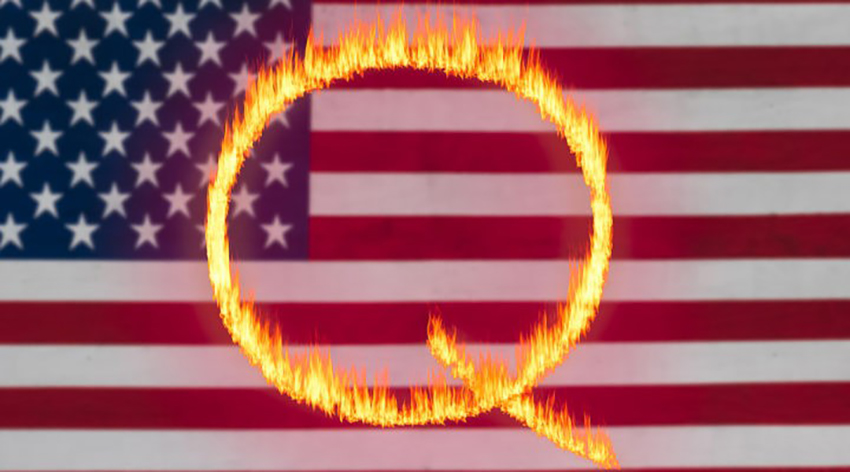
For instance, people who are prejudiced against Muslims might be motivated to believe any sort of false information that presents Muslims in a negative light, including conspiracy theories. This is consistent with evidence that participants’ beliefs in conspiracy theories depend on who the alleged conspirator is. Along those lines, some QAnon followers think that because Q is the 17th letter of the alphabet, former President Trump is sending them messages when he mentions the number 17.
On the surface it might seem difficult to separate legitimate beliefs from conspiracy theories, but it’s not. If you are willing to openly discuss your views, partake in open discussion, there is a good chance that you’ve not gone down the rabbit hole. If however, your posture is rigid and uncompromising, if you are unwilling to have an open discussion of views with others, you might want to take a look in the mirror. You can always seek feedback from family or friends, just be sure they are not in your same conspiracy group.
And how do you deal with family and friends that have passed the conspiracy point of no return? First of all, recognize that you will get nowhere discussing the issues. And this can get tricky because as the voice of reason, you run the risk of putting yourself in the role that these people are defending themselves against. But, you can ignore the political issue and talk about things like fear and insecurity and the control they have over their lives. Remember, there is only so much you can do unless they are open to hearing it.
James Baldwin on hate as a defense mechanism:
"I imagine one of the reasons people cling to their hates so stubbornly is because they sense, once hate is gone, they will be forced to deal with pain."
For Further Reading:
Conspiracy theories as part of history: The role of societal crisis situations van Prooijen, J. M. and Douglas, K. M., Memory Studies, Vol. 10, No. 3, 2017
Moulding, R., et al., Personality and Individual Differences, Vol. 98, 2016. "Better the devil you know than a world you don't? Intolerance of uncertainty and worldview explanations for belief in conspiracy theories."
The Psychology of Conspiracy Theories. Karen M. Douglas, Robbie M. Sutton, and Aleksandra Cichocka, School of Psychology, University of Kent.
copyright ©️ 2021 Blue Lotus Press
- Joshua Hart, Molly Graether. "Something’s Going on Here: Psychological Predictors of Belief in Conspiracy Theories.” Journal of Individual Differences, 2018; DOI: 10.1027/1614-0001/a000268
2. Karen Douglas, PhD, a professor of social psychology at the University of Kent, Current Directions in Psychological Science, Vol. 26, No. 6, 2017).
3. (Hart, J., & Graether, M., Journal of Individual Differences, Vol. 39, No. 4, 2018).
4. Romer, D. & Jamieson, K.H., Social Science & Medicine, Vol. 263, 2020. “Nearly a third of U.S. adults think the coronavirus is a bioweapon created by the Chinese government.”
