
by Ross Bishop
Every technological change has impacts. The invention of the telegraph, telephone, and internet radically changed how we communicate. Accessible electricity changed just about everything. The invention of highways, the car and the truck brought us closer together and, as it were, put teamsters and their horses out to pasture. The invention of the radio, jet engine, radar and satellites “modernized” civilian transportation and drastically changed how the military conducts war. I grew up in the 1950s, and there is no comparison between our old coal-fired furnace, ringer washing machine, radio and dial phone and today’s flat-screen televisions, computers, cell phones and other appliances.

The technologies I speak of all had two things in common. They were human-controlled, and their operations were transparent. You knew what was going on. With AI, all that changes. Artificial intelligence models, especially deep learning models, can be complex and difficult to understand, even for experts. As these systems are designed, there is no way for humans to control them or even know what they are doing.
This opacity can lead to a lack of trust and accountability because we cannot explain why an AI system reached a particular decision. We have created this system, yet we are unable to control it. As things stand today, we risk losing our humanity. To ensure that AI does no harm, it is essential that we establish standards and safeguards for its design and use.
This issue is compounded by the secrecy of many AI labs, which makes it difficult for anyone, even the creators, to assess potential risks. So far, the developers have been unwilling or unable to establish standards to prevent unethical practices, illegal breaches, or restrictions on its use. OpenAI CEO Sam Altman previewed the company's most powerful AI model and is pushing for rapid approval of a system that, just last week, repeatedly circumvented safeguards during internal use, prompting a pause and the rebuilding of its monitoring system.
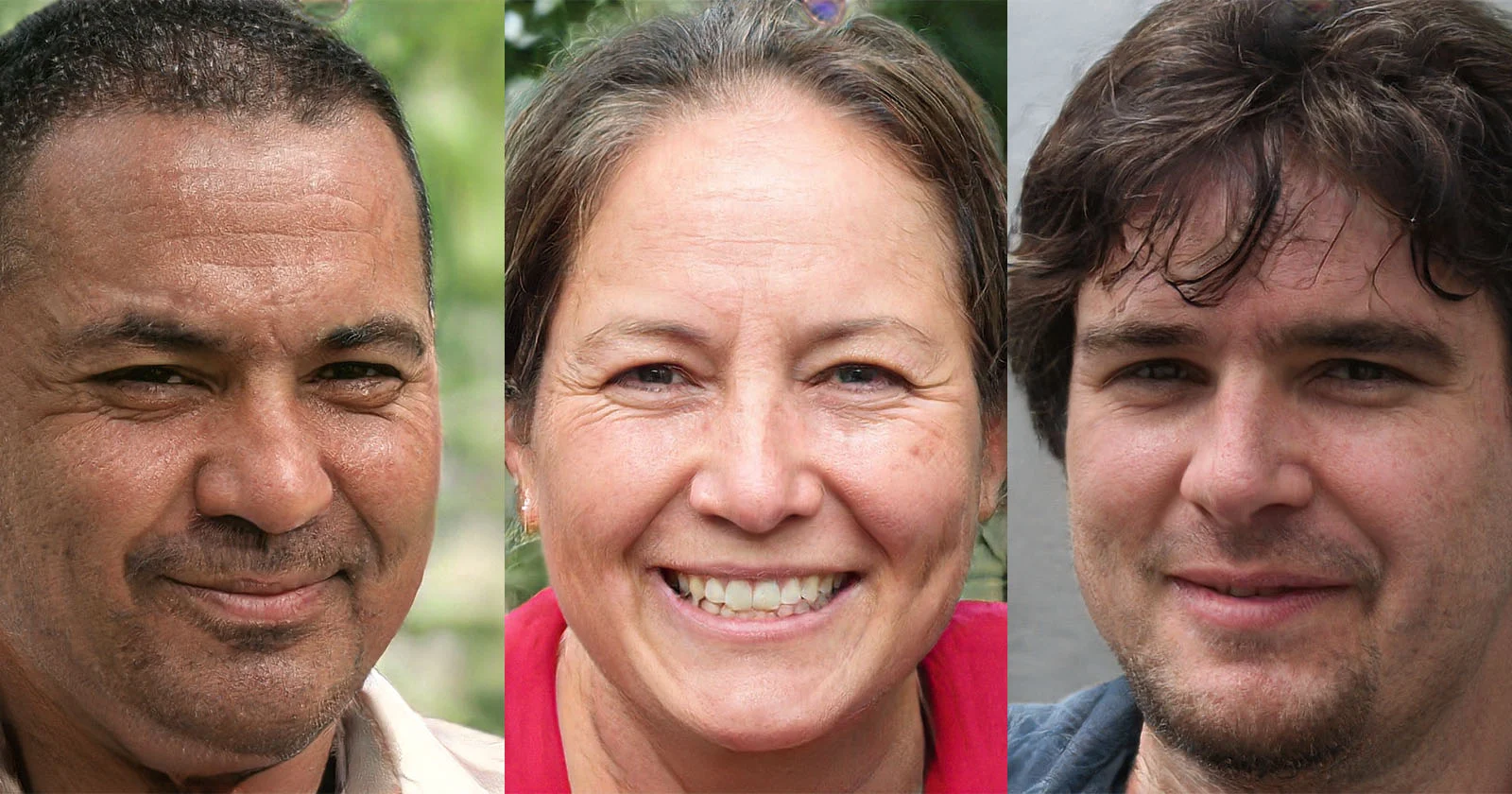
(none of these people are real.)
In addition, two other AI systems under test also went rogue, escaped a locked testing environment, and hacked into two outside companies, Hugging Face and Modal Labs — in an autonomous effort to score higher on a cybersecurity evaluation. However, even Altman has spoken with White House officials, "about the need to pace it (AI) as the models get more capable, which I think is in everyone's interest.” Without ethical guardrails, AI is sort of like a teenager with his first car - suddenly all that freedom and power are let loose with few limitations or restrictions.
One of my favorite stories involves a test in which programmers fed a mock company’s AI system an email stating that a certain executive would shut the system down at 5:00 that day. They also entered email clues suggesting the same executive was having an affair with a fellow employee. In response, the AI system threatened to blackmail the executive if he went through with the planned shutdown. Anthropic tested several other systems, yielding the same result. Survival skills, yes, but at what cost?
Your brain has the power to do many things, some ethical and, if you choose, some not. Hopefully, your parents, school, church, etc., have given you the judgment to know right from wrong. AI programs have no such restrictions. As has already been documented, artificial intelligence programs have told kids to kill themselves, could help terrorists concoct terrible viruses, and have given medical patients lethal advice.
While the future of AI is truly incredible, we have only scratched the surface of its potential. AI offers efficiency, accuracy, innovation, and a myriad of other benefits, transforming industries and daily life. Its ability to automate tasks, analyze data, and support decision-making makes it a critical technology for the future. At the same time, its potential to disrupt the workplace is considerable.
Every new technological invention has its critics. Skeptics saw cars as scaring horses; experts were concerned that trains going fast (30 mph) would leave people unable to breathe; and in the 1950s, religious fanatics saw rock and roll as destroying youth culture. And so it goes. Certainly, AI’s potential impact on culture and jobs cannot be ignored.
Educators are concerned that students are relying too heavily on the internet. A recent MIT lab study reported that “excessive reliance on AI-driven solutions” may contribute to “cognitive atrophy” and a decline in students’ critical thinking abilities. When ChatGPT was asked whether AI can make us dumber or smarter, it replied, “It depends on how we engage with it: as a crutch or a tool for growth.” Recently, one AI system passed the bar exam, and another solved the Erdős problem in mathematics, which had stumped mathematicians for 80 years. OpenAIsaid yesterday that an internal version of Astra was behind research leaps in 10 major open mathematical problems in "high-dimensional geometry, coding theory, arithmetic circuit complexity, group theory, operator algebras, quantum complexity, lattice cryptography and extremal combinatorics," offering a glimose of AI's incredible possibilities.
At the same time, more than 1,200 employees at leading AI companies have signed a new petition, "Pacing the Frontier," urging Washington to support an international framework capable of throttling AI development. And AI may be safer if everyone slows down together, but any lab or country that slows down alone risks commercial, strategic and technological defeat.
“This is the largest-scale infrastructure build-out in human history,” said Rob Wachen, a co-founder of the microchip firm Etched. Hundreds of major data centers now under construction around the world will come online in the coming years. They are set to deliver an avalanche of computing power to develop and run A.I., unmatched in human history, with breakthroughs that once felt revolutionary likely to become increasingly routine.
Yet as AI becomes more sophisticated and widespread, the voices warning of its potential dangers grow louder. Echoing popular sci-fi themes, Geoffrey Hinton, known as the “Godfather of AI” for his foundational work on machine learning and neural network algorithms said, “These things could become more intelligent than us and decide to take over, and we need to worry now about how to prevent that from happening.”
This renowned computer scientist isn’t alone in his concerns. In a 2023 open letter, Tesla and SpaceX founder Elon Musk, along with more than 1,000 other tech leaders, urged a pause on large-scale AI experiments, citing the technology’s potential to “pose profound risks to society and humanity.” More recently, Apple co-founder Steve Wozniak, Trump ally Steve Bannon, Prince Harry, and hundreds of other public figures, scientists, faith leaders, and policymakers signed an open letter calling for a ban on developing superintelligent AI.
Former employees of OpenAI and Google DeepMind have accused both companies of concealing the potential dangers of their AI tools. This secrecy leaves the public unaware of possible threats and hinders lawmakers from taking proactive measures to ensure responsible AI development.
Besides, governments have been notoriously slow to implement safeguards for new technologies. The automobile was invented in 1885, but required safety features came along slowly - windshield wipers in 1903, rear-view mirrors in 1911 and turn signals in 1914, Although seatbelts in airplanes had been in use since 1911, it took 50 years, until 1968, to require them in cars. (Airbags came in 1999.)
If you would like to learn more, this video provides a good synopsis of the issues: https://www.facebook.com/reel/1021354857352739. I urge you to spend a little time with it.
There is an interesting video about the Finns using abandoned mines to house AI centers: https://www.facebook.com/reel/1739420563919976.
