
by Ross Bishop
In an ideal world, the wealth and power of society would be used to lift and support everyone out of the dregs of poverty and disease. Even Adam Smith, long identified with the ideology of a dynamic, wealth-creating capitalism, in his Inquiry into the Nature and Causes of the Wealth of Nations (1776), draws a compelling picture of the market economy expanding in a way that distributes the benefits of "opulence" through all the ranks of society. He goes on to point out that well-being isn’t just about our relationship with things, it’s also about our relationship with each other. He speaks of “the injustice of inequality.”
Unfortunately Smith’s ethical standards have been completely corrupted by the followers of the free market economy. For 250 years Darwinian capitalism has literally moved mountains to feed, clothe, bring automobiles and streaming television to the masses. But the price we have paid for these things has been substantial. Nature has been gutted and parts of the planet are approaching inhabitability in support of our lust for consumer goods and to enrich the wealthy. Although we have made superficial progress, some parts of the planet are so polluted that it is dangerous to breathe the air or drink the water.

The social misfits - (all but a few successful artists, musicians, intellectuals, homeless people, authors, poets, PTSD soldiers, the mentally troubled and the offspring of former slaves) who don’t fit into the economic system by getting jobs, have been left by the side of the road, forced to live on handouts and the generosity of a few because they don’t or can’t “produce” anything useful.
A short journey back in history will illustrate the origins of our dilemma. England of the 1760’s was an agrarian society of cottage industries that produced essentials like food, clothing and pottery. Some have romanticized the age, because it was family based and nature centered, but life in those days was hard. Work was backbreaking and tools were primitive. There was little money, almost no education and a good deal of sickness and disease. People died young. Families were large to share the work. But they did live closer to nature. In those days they got around by horseback, so people didn’t travel much. You spent your life close to were you were born.
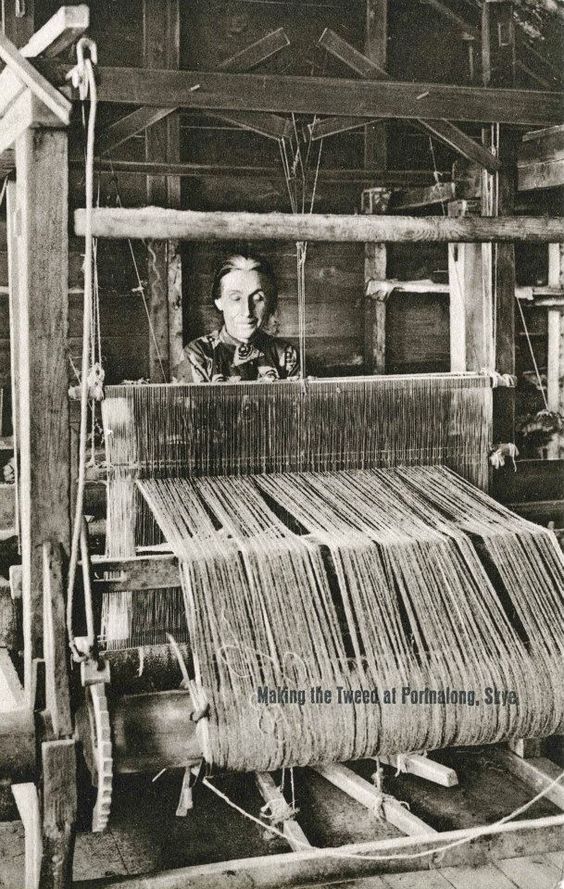
But the world around the cottages was changing rapidly. And in 1765 when James Watt developed the steam engine, the entire society was literally catapulted into the future. By1850, the nature of work had transitioned from being craft oriented to being factory-centric. Almost overnight, steam engines had replaced human effort in making everything.

Steam power meant centralization. And steam engines were expensive, opening the door to capitalists and financiers with the money to buy them. Factories brought workers out of the cottages and set the hours and pace of work.
Consider the impact on just one industry - textile weaving. The power weaving loom was developed in 1785. By 1803, there were 2,400 power looms in Britain, mostly powered by water. However, by 1833, just 30 years later, there were 100,000 steam powered looms in use in the textile factories of Britain.
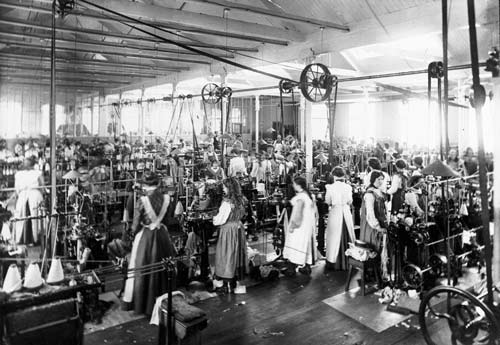
The impact throughout the Western world was that consumer goods became available and relatively inexpensive. They weren’t the quality of hand crafted items, but at least you had underwear, shoes and a shirt or a dress! (If you are interested in a perspective, James Galsworthy wrote an incredible “Essay On Quality” (https://www.thoughtco.com/quality-by-john-galsworthy-1690111) about the transition to manufacturing.)
The mechanization of manufacturing and resultant dramatic increases in scale and productivity, led to a rough and extremely rapid transition in both society and the economy. The resources needed to support industry consumed enormous quantities of coal and denuded England’s ancient forests. It also created unbelievable pollution. Also, Britain experienced a rapid increase in income disparity and the massive movement of people from farms to cities, with resulting urban squalor, as cottage industries simply faded away.
Children had been a significant contributor of labor in the cottage industry, tilling the fields, spinning yarn and running the looms, so the early factories sought to employ them. In Britain in 1788, two-thirds of the workers in cotton mills were children as young as five. Orphanages and poor houses provided ready sources of cheap labor. In 1815 Robert Owen argued that children should not be allowed into the factories until at least the age of ten. In 1842 a government report on conditions in the mines reported that five year old children were frequently used to mine coal. Their fathers "carry them down" as soon as they were able to walk, in order to work the mines.

Women and children left the cottages and labored under utterly brutal conditions. They worked long hours in hot, dusty conditions, and were forced to crawl through narrow spaces between fast-moving machinery. A working day of twelve hours was not uncommon, and accidents were frequent. Discipline was harsh, enforced by factory owners and their lackeys. Such was the motivating power of greed.

With the capitalists either unwilling or unable to control their abuses, regulation of business by government was the only available remedy. Beginning in the 1800’s and continuing through the Second World War, Western governments sought to control the unbridled powder of monopolies and corporate oligarchs. The Sherman and Clayton antitrust acts in this country were created to regulate those matters. The age was marked by labor strife as workers rebelled against unfair wages and dangerous working conditions.
These efforts continued into the 1950’s with the creation of things like the 40 hour week, overtime, safety regulations, the minimum wage, the abolition of child labor, Social Security, public education, welfare, Medicare, OSHA, anti-discrimination laws, etc., etc. None of these things were accomplished through corporate generosity and without strife and in some cases, bloodshed.
But after WWII and culminating in the Trickle Down Reagan years of the 1980’s, corporations realized that the only way to defeat the beast was to own it, and so they sought to buy off Congress and state legislatures “en masse,” with rather remarkable success. Years of social progress in worker safety and regulation were gutted and regulatory agencies were hamstrung. Restrictions on monopolies were ignored and government regulations were stripped. A corporate job became a big part of the American dream.
Today American grocery aisles are laden with chemically adulterated “food” blessed by the FDA. Our farmland is inundated with all sorts of petrochemicals and our oceans are increasingly depleted while becoming choked with “recycled” plastics. Old growth forests exist only in photographs. And even in the face of consistent scientific warnings, global warming continues, largely unabated. In addition, we face the new challenge of the unregulated monopoly of social networks, controlled by a new generation of oligarchs.
Mulled into complacency by creature comforts and fossil industry misinformation, the issue of global warming reaches well beyond the two year event horizon of most Americans, meaning that the public is not likely to react until it is unfortunately too late. Congress, driven by conservative Republicans, is already well down the rathole and most state legislatures have joined them. Notwithstanding a social movement like the Civil Rights movement of the 1960’s, there just isn’t a great deal of hope on the horizon. The future will determine if Western society drives itself of a cliff.
Copyright©2023 Blue Lotus Press
