
by Ross Bishop
For three thousand years, observers of history have noticed a most intriguing pattern in human behavior. It seems that we follow a cycle of war and peace every 100 years or so, and this has been true since time immemorial. Commenting on this phenomenon, the Roman Censorinus, writing in De die natale in 238 A.D., described “natural saeculae” as “very long spaces of a human life, defined by birth and death.”
George Modelski (1926-2014) divided the saeculae or seculum cycle into four quarter-century phases, later called “turnings,” each succeeding the last in a natural entropic progression. Turnings can also be regarded as seasons of history or phases of a person’s life, each lasting about 20 years and metaphorically corresponding to spring, summer, fall and winter.
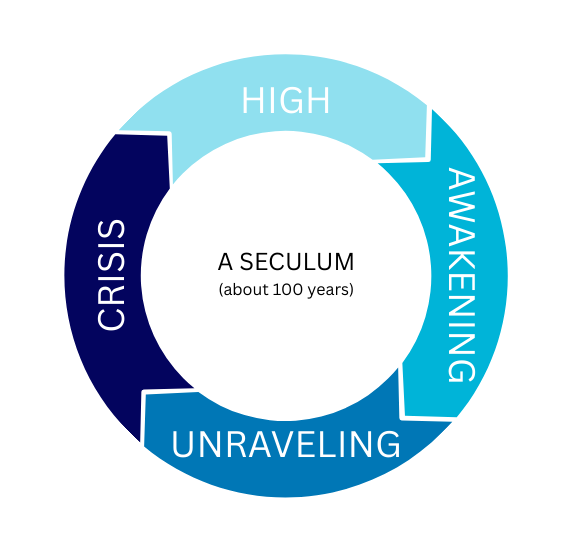
Giuseppe Ferrari (1812-1876) and Julian Marias (1914-2005) identified the four-part cycle: The first (revolutionary) generation (a Crisis) creates and initiates a new idea through struggle; then a harmonizing generation - a High - forms a conformist personality and uses that idea to establish community and build political institutions. The third reflects and theorizes (an Awakening), and the fourth, a preparatory generation, subtly undermines the harmony of the Awakening, and challenges existing forms and customs (an Unraveling), after which the cycle repeats. This has been true for as long as we have recorded history.
About a year and a half before the attack on Fort Sumter, President Abraham Lincoln was giving a speech, and as was his custom, he told them a story. It was about an Asiatic monarch who directed his wise men to come up with a statement “to be ever in view, and which should be true and appropriate in all times and situations.” After much discussion and considerable study, the sages offered this answer: “This, too, shall pass away.”
In their 1977 book, The Fourth Turning, Strauss and Howe write: “Events keep recurring and with great regularity. These are the solstices of the seculum: Crises and Awakenings. Over five centuries of Anglo-American history, no span of more than 50 years has ever elapsed without a Crisis or Awakening. Every generation has thus been shaped either by a Crisis or Awakening during one of its first two phases of life and has encountered both a Crisis and an Awakening at some point through its life cycle.”
Gerhard Masur (1901-1975) explained that the word Crisis came to mean “a sudden acceleration of the historical process in a terrifying manner,” sufficient to “release economic, social and moral forces of unforeseen power and dimensions, making return to the prior status quo virtually impossible.” He saw this as leading to war.
Anthony Wallace (1815-1923) explained a Crisis: “A revitalization movement is a deliberate, organized, conscious effort by members of a society to construct a more satisfying culture.” A collective response to “chronic, measurable stress.” This phase is marked by a universal perception that the old global political structure has perished and that a new one must be born. (Recent Crisis: 1929-1946)
Arnold Toynbee argued that wars recur at periodic intervals because of their effects on people of different ages. The young soldiers of one great war, later, as elder leaders, refrain from declaring another war. Those who have no memory of war later become the declarers of the next great war. When you insert transitional generations between the war fighters and the war declarers, you can construct a four-part cycle spanning one seculum.
The Awakening is the other polarity of the seculum. The Awakening is to Crisis as summer is to winter, and love is to strife. Within each lies the causal germ of its opposite. The Awakening arrives with dramatic challenges to the High’s assumptions about benevolent reason and congenial institutions. The outer world feels trivial compared with the inner world. Society begins to search for the soul rather than for science. New spiritual agendas and social ideas spring forth. Youth-inspired attacks erupt against the established institutional order. Collective discipline and order are challenged. Public order deteriorates.
Where a Crisis rearranges the outer world of power and politics, an Awakening elevates the individual and reinvents private space. Wallace wrote that an Awakening is “a deliberate, conscious, organized effort by members of a society to construct a more satisfying culture.” These movements are a collective response to “chronic, measurable stress.” (Recent Awakening: 1964-1984)
And if Awakenings are the summers and Crises are the winters of human experience, transitional eras known as a High and an Unraveling make up the other turnings. In the post-Crisis era, the High warms and lightens, while the post-Awakening era (the Unraveling) chills and darkens. In spring, consensus, order, and stability prevail, while in autumn, argument, fragmentation, and uncertainty dominate.
In Modelski’s second-quarter Deligitimization phase, which he describes as the season of “internal renovation” and “revitalization of the system’s normative foundations,” a second-quadrant (Awakening) era is necessary to replace the inner-world structure of culture and values, just as a fourth-quadrant (Unraveling) era is necessary to replace the outer-world structure of political and social values. (recent Unraveling: 1984-2004)
A High brings a renaissance to community life. With a new civic order in place, people want to put the Crisis behind them and feel content with what they have collectively achieved. In this phase, society demands order and consensus. The need for security becomes paramount. Social issues left unresolved by the Crisis will persist, providing fodder for future cycles. Eventually, society seems under control but devoid of spirituality. People can do everything, but they don’t feel much. (recent High: 1946-1964)
There are many examples of this cyclical recurrence in European and Asian history, but looking just at our own record for a moment, 85 years passed between the attack on Pearl Harbor and the attack on Fort Sumter, marking the opening of the Civil War. If you go back another 85 years, you find the Declaration of Independence. Go forward from the Civil War, and it was 64 years to 1944 (WWII), and then 67 more years to the terrorist attacks of 2011.
Strauss and Howe make the interesting observation that “Every forty years or so, the persona of each phase of life becomes nearly the opposite of that established by the generation that had once passed through it." . . . Reflect back as far as you can and recall how the persona of people (at any stage of life) changes completely every two decades or so. "During WWII, we were proud as a people but modest as individuals. When asked, fewer than two in ten said they were important. By 1970, more than six in ten said they were.”
It is incorrect to suppose, as some do, that most young generations come of age with attitudes (toward life, politics and culture) similar to those of their elders when they were young. Going back five hundred years, this has never happened. And this is important! Scholars (and others) tend to project the present onto a linear trajectory into the future, and that has never been the case.
In a compelling proof of the cyclical theory, Strauss and Howe write: “Imagine a scenario in which most of history’s ‘noise’ is suppressed. Imagine a single large society that has never had a powerful neighbor and that, for centuries, has remained relatively isolated from foreign interference. Imagine, finally, that this thoroughly modern society has acquired a reputation for pursuing linear progress and for suppressing the cycles of nature, unequalled by any other people on earth. From what you know about the seculum, wouldn’t you suppose that its history is governed by a cycle of astonishing regularity? Indeed you would. . . .But, of course, this society is no hypothesis. This society is America."
Where this gets interesting is that a child born in a particular turning will acquire characteristics unique to that period. Those unique characteristics will persist as the child moves into adulthood, midlife, and eventually elderhood, impacting his or her role as parent, citizen, and eventually social elder. These patterns shape history and, in doing so, shape the next generation from their experience in childhood and as young adults.
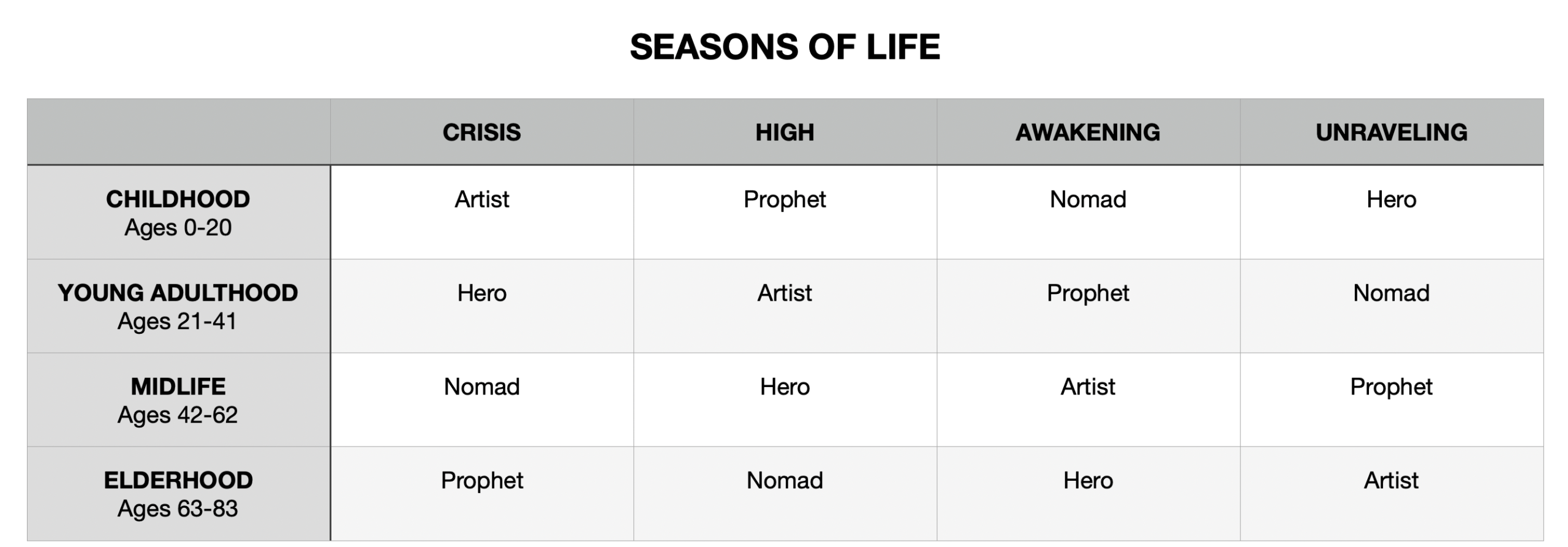
These phases and social roles are typically used to categorize the typical life cycle:
CHILDHOOD - (ages 0 - 20) Growth, nurturing, and acquiring values.
YOUNG ADULTHOOD - (ages 21 - 41) Vitality, serving institution, testing values.
MIDLIFE - (ages 42 - 62) Power, managing institutions, applying values.
ELDERHOOD - (ages 63 - 83) Leadership, leading institutions. transferring values.
LATE ELDERHOOD - (ages 84+) Dependence, receiving comfort from institutions, remembering values.
Click image to enlarge
What follows are phases that have been defined as particular social Archetypes by the social environment into which each is born. In certain respects, each generation retains its youthful persona, and in others, it expresses it very differently at different phases of life.
HERO - Born during an Unraveling (1924-1944), grows up as a protected post-Awakening child and comes of age during a Crisis. Is a team-oriented young achiever. Heroes demonstrate hubris as confident midlifers and age into powerful elders who preside over the next Awakening. (America’s Greatest Generation)
PROPHET - Born during a High (1944-1964), they enter young adulthood during an Awakening. Best remembered for their coming-of-age passion. Increasingly indulged children grow up as narcissistic, defiant young crusaders, cultivate principle as moralistic midlifers, and become increasingly protective as parents. They age into detached, visionary elders who preside over the next Crisis. Their principal endowments lie in the domains of vision, values, and religion. (Boomers)
NOMAD - Born in an Awakening (1964-1984), enters young adulthood in an Unraveling. Grows up as an underprotected child, comes of age as an alienated young adult in a post-Awakening world. Mellows into a pragmatic midlife, adopting a hands-on, get-it-done leadership style, and becomes an overprotective parent during a Crisis. Ages into a tough post-Crisis elder.
ARTIST - Born in a Crisis (1984-2004), enters young adulthood in a High. Grows up as an overprotected child, comes of age as a sensitive young adult in a post-Crisis era. Later breaks free as an indecisive midlife leader with flexible, consensus-building leadership skills during an Awakening, and ages into an empathetic post-Awakening elder.
RECENT TURNINGS
The First Turning - a High (1946 - 1964): The energy of post-WWII. The creation of a consumer society with an emphasis on family. The evolution of the suburbs. An era of good feelings. A little penchant for spiritual reflection. Cleaned up from the preceding Crisis and set the table for the Awakening to follow. Gave an infusion of optimism and incredible constructive energy that was spiritually stale.
The Second Turning - an Awakening (1964 - 1984): Known as the “Consciousness Revolution,” it began with the Kennedy assassination and continued with long, hot summers and the Beatles. The Berkeley Free Speech Movement raged against the establishment. The Gulf of Tonkin incident sparked a decades-long confrontation between young people and the political establishment. As a result, LBJ was hounded out of office.
The Third Turning - an Unraveling (1984 - 2025): Culture Wars. From Reagan’s “Morning in America” in 1984 to Trump and MAGA in 2008 and again in 2024. Many people were comfortable with what America had become. Remember the Apple Computer ad featuring a young woman wielding a sledgehammer to smash an image of dull-faced 1950s men, with a voice-over saying, “1984 won’t be like 1984!” America smiled at the crushing of Big Brother.
The new values regime was no longer controversial. The rebels were inside the gates. Public trust sank to new lows. New Age Spirituality was everywhere. Behavior gaps widened between genders, races, religions, generations and especially between those who had children and those who did not. The era of the conventional family was no longer the norm (it is now 26% compared with 40% in 1970). President Clinton proclaimed that, “The era of big government is over.” The gap between the rich and the poor was widening.
The Fourth Turning - a Crisis (2025 - 2045): The script has yet to be written, but so far, the potential situation is explosive! Trump, MAGA, the Republican Congress, ICE and a complicit Supreme Court have set the stage for unprecedented social conflict. The last two years of the Trump administration, if he survives impeachment, promise to be an unprecedented political and social brawl.
